
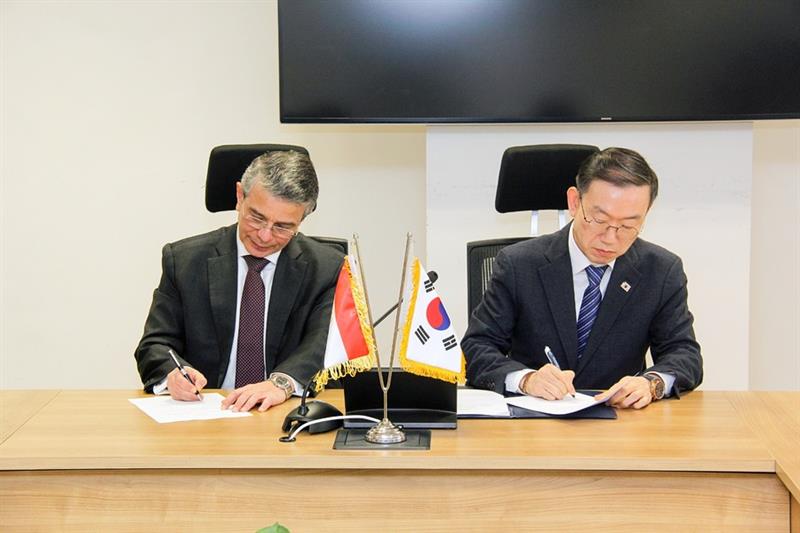
The Egyptian Customs Authority (ECA) has signed a memorandum of understanding (MoU) with its Korean counterpart, the Korea Customs Service (KCS) to enhance customs operations’ technological systems and improve e-commerce in Egypt.
The MoU aims to reduce clearance times and improve services and efficiency in Egypt’s customs system, according to Head of ECA Ahmed Amoui said on Tuesday, December 23, 2025, during the signing ceremony.
The ECA, he added, will also leverage Korean technological expertise to increase growth in smart systems, e-commerce, and modern logistics services within the ECA.
The agreement also includes plans to build staff capacity and improve integrated logistics for express mail shipments.
Amoui said the move reflects Egypt’s efforts to enhance technical and technological cooperation with international partners, as part of its broader strategy of digital transformation.
Egypt has been pressing ahead with efforts to facilitate its customs procedures, investing in its digital capabilities, and qualifying staff’s skills employing digital systems to boost the investment environment.
As part of these efforts, the ECA held meetings with KCS last week, during a visit by a Korean delegation to discuss ways to bolster the exchange of expertise, and explore for smart systems in the customs sector.
The KCS delegation also assessed Alexandria’s technology sector and the e-commerce system to identify potential development opportunities.
Finance Minister Ahmed Kouchouk recently announced plans to roll out a new package of customs facilitation measures, though no launch date was disclosed.
The step is part of broader efforts by Egypt to position itself as a regional manufacturing and export hub serving Africa, Europe and Asia, improve the business environment, attract investment flows and ease tax and customs procedures.
Customs reform forms a key pillar of Egypt’s program with the International Monetary Fund (IMF), which includes greater digitalization, simplified procedures and reduced bureaucratic delays aimed at boosting investor confidence and trade flows.
Egypt’s trade shrank by 27.6 percent to $3.3 billion in September 2025 compared to the same month in 2024, on the back of a 28.2 percent increase in exports, which reached $4.9 billion compared to $3.8 billion in September 2024.