
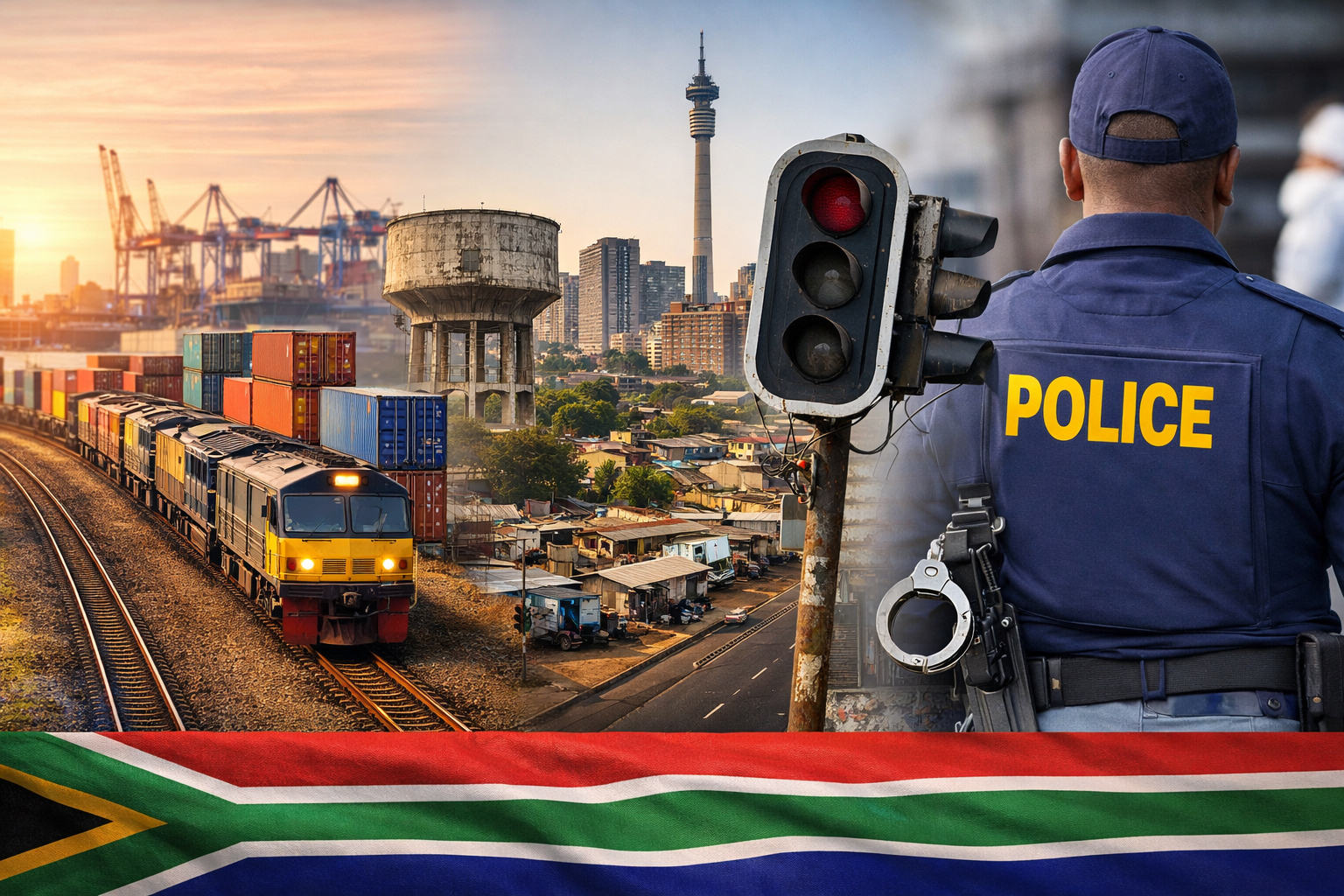
Business leaders say logistics, local government and justice reform are the keys to unlocking sustained economic expansion.
South Africa has a clear pathway to higher and more sustained economic growth if it can make decisive progress in three critical areas: logistics infrastructure, local government service delivery, and the effectiveness of the criminal justice system.
Addressing these constraints could position the country to break out of a prolonged low growth cycle and achieve GDP growth above 2%, according to Business Leadership South Africa.
South Africa has not recorded two consecutive years of economic growth above 2% for more than a decade, says BLSA CEO Busi Mavuso, who argues that structural bottlenecks continue to weigh heavily on investment, productivity, and business confidence.
Logistics reform is emerging as one of the most promising levers for change. In rail, 11 private operators have been selected to run 41 routes across six corridors, a move expected to significantly expand capacity and improve reliability.
Commercial negotiations between Transnet and the operators are under way to finalise access agreements of up to ten years, with the first operations scheduled to begin in the second half of this year.
Improved rail performance would give mining companies, agricultural exporters, and manufacturers the certainty they need to commit to expansion and long-term investment, Mavuso says.
Ports are also beginning to show momentum. Transnet concluded its first major port concession deal in December for Durban’s Container Terminal Pier 2, which will now be operated by International Container Terminal Services for the next 25 years.
The terminal handles more than 40% of South Africa’s container volumes, making efficiency improvements at the port economically significant. A similar concession has been signed for Cape Town’s liquid bulk terminal with FFS Tank Terminals.
“More concessions should result in genuine competition between ports to offer businesses better services, while rail companies will compete to move goods to those ports efficiently and cost effectively.
These breakthroughs must deliver a shift in the reliability of the logistics system. We need to see South Africa’s ports move up the global efficiency rankings, while reducing the cost of getting goods to markets.”
A more reliable logistics system would unlock investment by reducing uncertainty and lowering costs, turning marginal projects into viable opportunities.
Beyond logistics, local government performance remains a major drag on growth. Johannesburg, the country’s economic hub, highlights the scale of the challenge. Extended water outages, high leakage rates, and inadequate storage capacity reflect decades of deferred maintenance and governance failures.
Similar problems affect electricity distribution, road maintenance, traffic management, and refuse collection across major metros, directly increasing business costs and undermining productivity.
Structural reform initiative Operation Vulindlela is set to roll out targeted municipal interventions in 2026. Central to these reforms is the ring fencing of utility revenues to ensure that funds collected for water and electricity are reinvested into maintaining and upgrading infrastructure.
“This will address a fundamental governance failure where utilities have been treated as cash cows rather than infrastructure that requires constant investment,” Mavuso says.
Operation Vulindlela is also supporting capacity building by pairing private sector technical experts with municipal engineers, an approach that has already shown success in electricity reform.
The third pillar for unlocking growth is reform of the criminal justice system. The Madlanga Commission has documented deep dysfunction within the police, ranging from political interference to failures in evidence handling and case management.
“When the final report emerges, government must use it to set a new baseline for police reform, the way the Hefer Commission enabled the South African Revenue Service’s transformation or the Mpati Commission underpinned the Public Investment Corporation’s rehabilitation.
However, this requires political will to implement uncomfortable recommendations about removing compromised officials and rebuilding investigative capacity.”
Mavuso stresses that these three priorities are interconnected and form the enabling environment that either attracts or repels investment.
“When local and foreign investors ask when South Africa will achieve sustained economic growth above 2%, they are really asking when we’ll have resolved these fundamental constraints.
We have not had two consecutive years of more than 2% growth for more than a decade, but 2026 could mark the beginning, if we deliver on these three priorities.”
Execution, she emphasises, is now critical.
“We now need execution. Transnet must move rail and port concessions from agreements to operations, municipalities must implement revenue ring-fencing and accept technical support, and government must act on Justice Madlanga’s findings and empower the new National Director of Public Prosecutions Jan Lekgoa Mothibi.”
BLSA says it will continue working closely with government and its members across all three areas. The successful collaboration that ended loadshedding and delivered the G20 summit has shown what is possible when focus and coordination are applied.
Applying that same approach to logistics, local government and criminal justice could unlock the growth trajectory South Africa urgently needs.