

By Francois Nortjé, Port of Gauteng
South Africa’s most important trade and tourism corridor connects the Port of Durban to Gauteng and the northern provinces, carrying millions of travellers annually to KwaZulu-Natal’s beaches, bush, and the Drakensberg, while moving vehicles, consumer goods, minerals, and agricultural exports in vast volumes.
Despite its significance, the corridor has remained structurally unbalanced for years. Analysis shows that the Durban–Gauteng container rail corridor suffers from systemic design flaws that disadvantage rail transport.
Built-In Imbalance
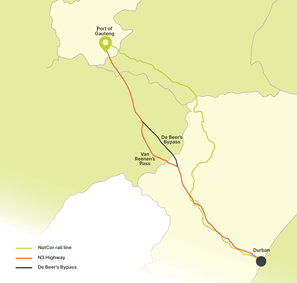
Transnet reports annual losses of roughly R2.3 billion on the corridor. Rail travels 690 kilometres, compared to the road’s 550 kilometres, a structural 140-kilometre, or 25% disadvantage for rail.
Ongoing improvements along the N3, including the planned De Beers Bypass, are increasing road’s advantage. Consequently, freight has steadily migrated to road, adding congestion on the N3 and undermining rail’s financial sustainability.
Rising Trade Pressure
The imbalance grows more critical as South Africa moves toward higher-volume, lower-margin trade flows. Exports of minerals and agricultural products continue to expand, while imports rise due to a stronger rand and stimulating economic activity.
Passenger vehicle imports alone have risen 28% year-on-year, increasing both passenger traffic and heavy vehicle movements along the N3. Global e-commerce platforms like Shein, Amazon, and Temu are shifting more distribution from air to ocean freight, further increasing container volumes through Durban.
Without reform, congestion, logistics costs, and safety risks will rise, undermining South Africa’s competitiveness.
Global Shifts Reshaping Trade
China’s property market slowdown is redirecting industrial output toward exports, flooding global markets with competitively priced manufactured goods. For South Africa, this translates into a lower-margin trade environment, with imports of vehicles, electronics, clothing, and appliances dominating container flows through Durban.
Logistics efficiency will be decisive in this environment. Inland ports such as the Port of Gauteng are strategically important, offering faster, cheaper movement of goods with minimal handling.
Safety, Tourism, and Infrastructure
The N3 is also a vital passenger corridor linking Gauteng and KwaZulu-Natal. Heavy reliance on road freight introduces growing risks:
- Safety: More trucks increase the likelihood of accidents and prolonged closures.
- Infrastructure imbalance: Roads carry excessive freight while rail remains underutilised.
- Congestion: Peak holiday traffic creates bottlenecks, discouraging tourism.
Restoring balance between road and rail is essential for safety, efficiency, and economic growth.
The Cure: Rebalancing the Corridor
Systemic reform combining regulatory change, private investment, and sustainable funding is required. A key opportunity arises when the N3 Toll Concession expires in 2029. Redirection of toll revenues to the Transnet Rail Infrastructure Manager (TRIM) could create a structured cross-subsidy for rail, supporting the National Development Plan’s goal of shifting 50% of freight from road to rail.
Reform and Investment
The Department of Transport’s 2025 Request for Information confirmed the corridor’s challenges are structural and financial, not operational. The creation of TRIM separates infrastructure management from train operations and enables non-discriminatory open access.
SANRAL’s budget reductions have prompted consideration of tolling mechanisms for heavy freight vehicles. TRIM is expected to announce 11 selected private bidders in April 2026, signalling the transition toward a competitive multi-operator rail environment.
Transnet will appoint advisors to prepare a bankable corridor business case, while projects such as the Durban Pier 2 partnership with ICTSI and a proposed 25-year Johannesburg–Durban corridor concession aim to mobilise long-term private capital.
Policy Alignment
Government policy now supports these reforms. The 2026 Budget Speech placed logistics and transport at the centre of economic growth, with public infrastructure spending expected to exceed R1 trillion over the medium term.
Industry support for the initiative is strong; what remains is full implementation.
A National Call to Action
South Africa’s critical corridor must serve both freight and passengers efficiently. Without intervention, congestion, safety risks, and the road-rail imbalance will deepen, harming tourism and economic activity.
When the N3 concession expires in 2029, part of the surplus should be reinvested in rail infrastructure through TRIM, restoring balance, reducing heavy truck volumes, and ensuring long-term sustainability of the country’s most important trade route.
The imbalance has been diagnosed.
The correction has begun.
The wheels are turning.