
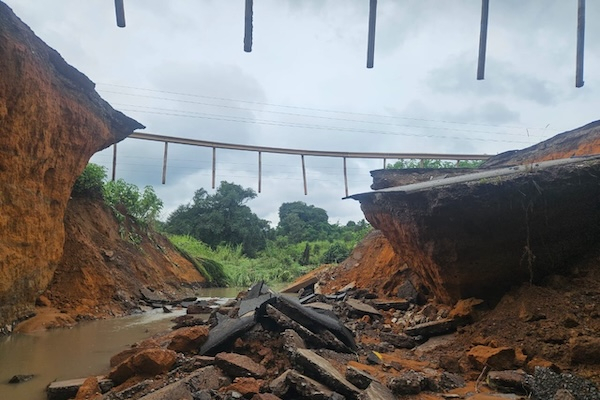
The Walvis Bay Corridor Group has reported that 700 SADC truck drivers have been forced to take alternative routes to the Democratic Republic of Congo (DRC) after heavy rainfall destroyed a key bridge at the Kasumbalesa Border Post in Zambia on Sunday.
Although Zambian authorities temporarily fixed the Kakoso Bridge within 48 hours, the disruption has already had a significant impact on local companies.
The bridge collapse delayed the transportation of mining inputs, fuel, and mineral exports such as copper and cobalt to and from the DRC, affecting trade flows across the Southern African Development Community (SADC).
The high-traffic border post typically handles 1,500 truck movements per day, with 700 of these originating from SADC countries. Some logistics companies told The Namibian that, on top of the N$150,000 they spend on fuel and tollgate charges, they were forced to spend additional funds to navigate alternative routes.
Maria Paulus, spokesperson for the Walvis Bay Corridor Group, told The Namibian yesterday that, “the temporary disruption has significantly affected the daily movements of over 1,400 trucks on the Zambia-DRC trade route. The damage caused immediate diversions, longer travel times, higher fuel and operational costs for transporters.”
She added, “Although the temporary road and detour is now operational, we anticipate that some delays may still occur as traffic flow stabilises. Due to the traffic progressively returning to the main corridor, we would like to urge transporters using the Mukambo route to still exercise caution, especially, during the rainy season due to poor road conditions that may pose a safety risk to heavily loaded trucks.”
The group will continue to monitor developments along the Walvis Bay-Ndola-Lubumbashi Development Corridor, as well as other corridors, to strengthen trade facilitation measures and minimize disruptions and bottlenecks.
Bargaining and Financial Pressure
Namibian Revolutionary Transport and Manufacturing Union leader Petersen Kambinda noted that the collapsed bridge has put added pressure on truck drivers and owners to find alternative routes, increasing fuel, subsistence, and travel costs. He said, “Our main concern is the after effects because it now means that our people who were already on route will either remain somewhere where they need more S&T to wait until an alternative route has been made, or more fuel for them to take the alternative routes.”
Kambinda further cautioned that logistics delays could impact negotiations between trucking companies and the union regarding improvements in drivers’ working conditions, as funds are being depleted to cover alternative routes.
CBM Logistics’ Marlene Strong echoed these concerns, explaining that transport disruptions significantly increase the already high costs logistics companies incur. She said, “There is a high expense on the transport business. Our drivers transport the goods to DRC and back within two to three weeks. It cost us N$150,000 for fuel and tollgate fees. When drivers return, we have to invoice and wait for payment. A day off impacts us.”