
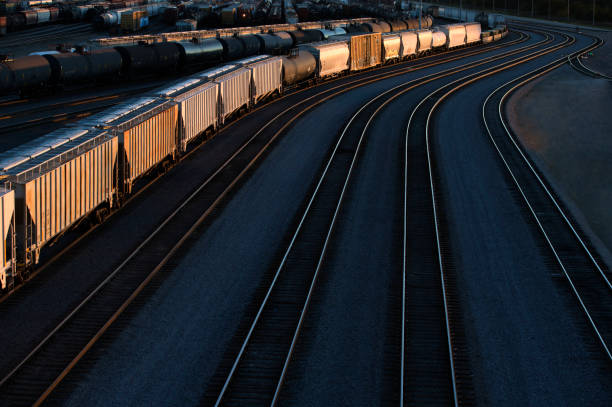
Ore Users Forum outlines rehabilitation plan and long term logistics solution for Northern Cape to Saldanha route
South Africa’s iron ore export corridor from the Northern Cape to the Port of Saldanha is at a critical turning point. With volumes under pressure in recent years, industry leaders are aligning around a clear recovery plan that could restore capacity, improve competitiveness and unlock future growth.
Speaking at the Investing in African Mining Indaba 2026 in Cape Town, Kumba Iron Ore integrated sales and operational planning and logistics head Wimpie Pienaar outlined the Ore Users Forum’s roadmap for revitalising the 861 km corridor.
When weighing the future of the iron ore export corridor, the Ore Users Forum has a defined direction, or “north star”, said Pienaar.
He emphasised that infrastructure rehabilitation is the immediate priority.
“Firstly, we need to make sure that the infrastructure is rehabilitated…what needs to happen on both the rail line and at the Port of Saldanha is that we need to fix the infrastructure,” noted Pienaar.
Through collaboration between Transnet and the Ore Users Forum, a technical assessment was launched in 2024 to establish a single version of the truth about the corridor’s challenges.
“Through collaboration between Transnet and the OUF we kicked off a technical assessment back in 2024, and that assessment gave us one version of the truth about what the actual problems are on the corridor.
“So, we know exactly what needs to be done to get the system back to capacity of around 60 million tons for iron ore.”
Currently, the corridor transports between 50 million and 55 million tons per year, below its optimal capacity.
Looking beyond immediate repairs, the Ore Users Forum is advocating for structural reform.
“In the long term, the OUF has been vocal in saying that we believe that an integrated concession for that corridor all the way down from the Northern Cape 861 km to the Port of Saldanha, would be the best outcome for country,” added Pienaar.
“So an integrated concession, where a third party rails manganese and iron ore on that system, and Transnet remains the asset owner.
“We believe that type of solution is the best chance to restore the system for iron ore, and to also introduce manganese and ramp up the volumes we are currently seeing.”
Such a model would allow private sector participation while maintaining public ownership of the assets, a structure increasingly discussed as a solution to South Africa’s broader rail and port logistics challenges.
Pienaar described the iron ore export journey over the past few years as painful, though he acknowledged recent improvements under Transnet’s new leadership team.
“Since 2020 we have seen a decline in performance in the volumes being allocated to exporters on the ore export corridor.”
In response to declining volumes and shared operational constraints, the four iron ore exporters using the corridor formed the Ore Users Forum.
“We then established the OUF, which is the collaboration between the four exporters of iron ore that share the same destination at the moment.”
Like coal exporters, iron ore producers face limited logistics alternatives.
“Similar to coal, we struggle with two things,” noted Pienaar.
“Firstly, we don’t have an alternative but to rail our volumes down to Saldanha. It doesn’t make competitive sense to put it on trucks.
“We had stranded product stockpiled, and we couldn’t monetise that product.”
Although iron ore exports from the Northern Cape represent significant volumes domestically, they account for less than 5 percent of global seaborne iron ore trade. That reality makes efficiency and cost control critical.
“What an uncompetitive logistics system does is that it impacts your competitiveness,” said Pienaar.
“At the end of the day, you compete with gorillas [large global mining companies], and if your logistics cost are too high and your logistics performance is unpredictable, it puts you on the backfoot.”
For South Africa to remain competitive in global iron ore markets, restoring corridor performance is essential. The combination of infrastructure rehabilitation, structured collaboration between Transnet and exporters, and a potential integrated concession model could mark a turning point.