
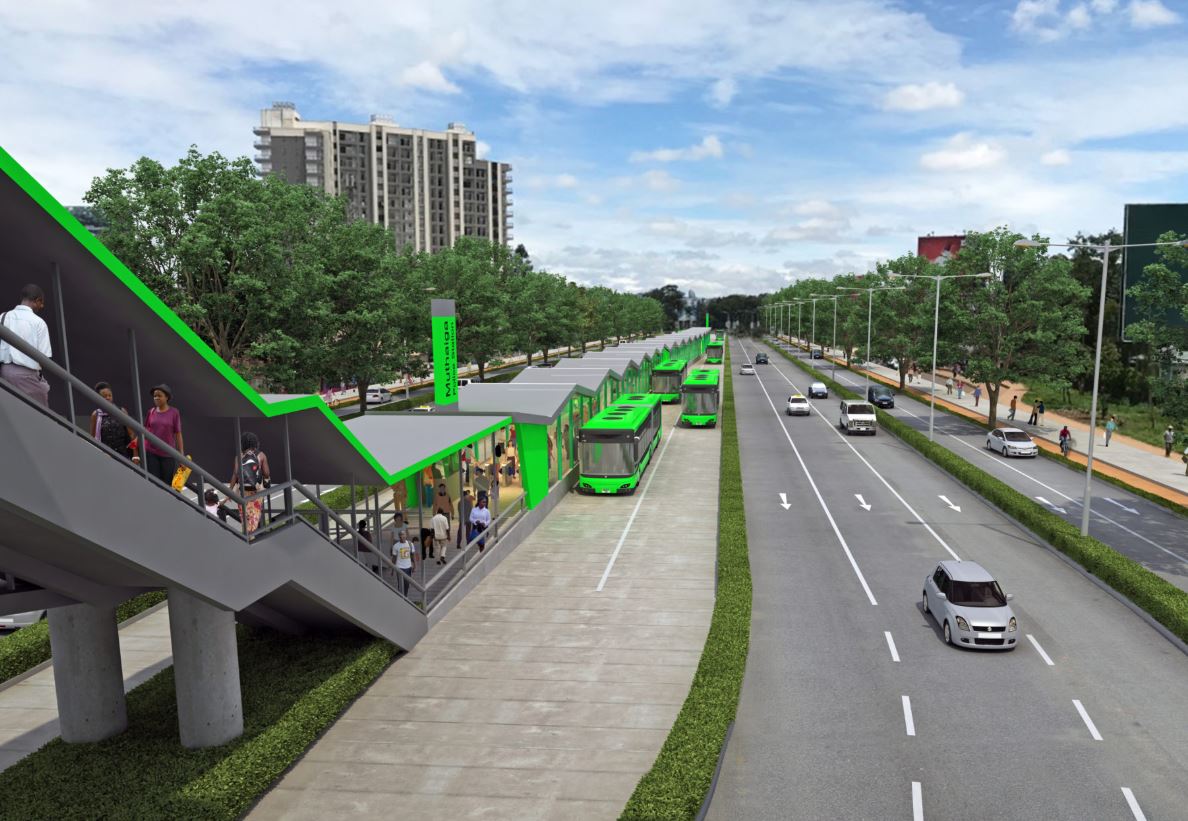
The Government of Kenya has secured $1.7 billion (Ksh219 billion) in funding for Phase 1 of the Nairobi Metropolitan Integrated Transport System (NMITS), a landmark infrastructure project aimed at addressing chronic congestion across the capital’s metropolitan area.
Prime Cabinet Secretary Musalia Mudavadi confirmed the financing during a meeting with representatives from the G7 and Kenya’s development partners, where they reviewed the status of pilot programmes under the NMITS framework. The project’s ultimate goal is to improve mobility, enhance accessibility, and promote a more sustainable urban environment.
A key component of the initiative is the upgrade of the Nairobi Central Railway Station, which will act as the hub for an integrated network that includes two bus rapid transit (BRT) corridors, commuter rail lines, and a link to the Standard Gauge Railway from Syokimau. Once fully operational, the system is expected to carry up to 30,000 passengers per hour by 2030.
BRT corridors
Five BRT corridors have been gazetted under the plan: Line 2 (Simba) along Thika Superhighway is currently undergoing upgrades, Line 3 (Chui) is at an advanced planning stage, with detailed designs for Phase I completed. Other corridors, including Line 1 (alongside Nairobi Expressway) and Line 4 (funded by the African Development Bank), are in various stages of development. Routes like Dandora–Hospitals and Mama Lucy–Kikuyu are also being planned.
The rehabilitation of 165 kilometers of existing commuter rail infrastructure is underway, with new links such as the Riruta–Ngong–Kiserian–Ongata Rongai line in the pipeline. A major focus of NMITS is Non-Motorized Transport (NMT). Nairobi’s NMT policy mandates the inclusion of walkways and cycle lanes in all new roads, with 20% of the transport budget allocated to NMT. Projects like Kazi Mtaani and the Nairobi Missing Link Roads are already addressing pedestrian and cyclist infrastructure.
Construction of Phase 1 is expected to commence by the end of 2025 and conclude in 2027. However, a funding gap of $2.2 billion remains. The government is targeting resource mobilization by September 2025 to close the shortfall. Mudavadi reaffirmed the government’s commitment to decongest Nairobi, promising safer, more efficient, and inclusive transport solutions upon the project’s completion.