
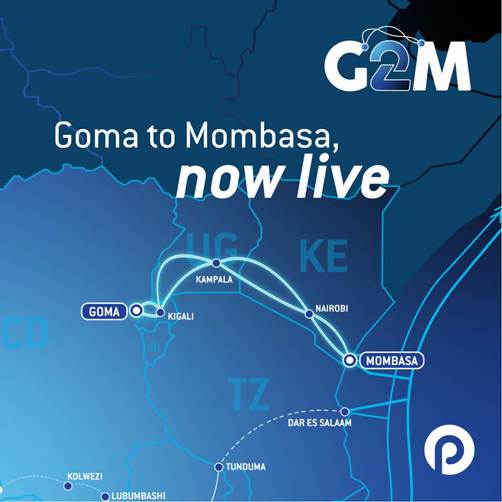
New G2M fiber network strengthens cross-border connectivity, enhances resilience and opens commercial opportunities across Kenya, Uganda, Rwanda and the DRC
East Africa’s digital landscape has taken a major leap forward with the launch of the G2M (Goma-to-Mombasa) fiber route, a 2,000-kilometer terrestrial network connecting Mombasa in Kenya to Goma in the Democratic Republic of Congo via Kigali and Kampala.
Operated by Pan-African telecommunications provider Paratus Group, the route is now live, carrying traffic for its first wholesale customers and delivering high-capacity, resilient connectivity designed for carriers, ISPs and enterprise clients.
“This is far more than another fiber link – it’s a new digital highway for the region,” says Martin Cox, Chief Commercial Officer of Paratus Group.
“By creating a protected route from the coast all the way into Goma, we’re giving operators and enterprises direct, reliable access to global capacity. It dramatically improves resilience and performance, while opening new commercial opportunities across Kenya, Uganda, Rwanda and the DRC.”
The G2M fiber route not only strengthens Paratus’ East African footprint but also links inland markets directly to global subsea cable capacity at the coast.
In partnership with ROKE TELKOM in Uganda and MoveOn Telecoms in Kenya, Paratus is fully licensed across the region through its subsidiaries, Paratus Rwanda, Paratus Uganda and Paratus Kenya.
The new route complements Paratus’ LEO footprint in the region and integrates with its broader East–West fiber backbone stretching from Maputo to Swakopmund, connecting to the Equiano subsea cable for low-latency, high-capacity redundancy between Africa and Europe.
“Our strategy has always been about connecting the dots across Africa with quality, contiguous infrastructure,” Cox adds. “The G2M route strengthens everything we’ve already built in East Africa and makes Paratus the natural connectivity partner for businesses that operate across borders.”
For businesses and service providers in eastern DRC and neighboring countries, the G2M route translates into faster access to international networks, lower latency, and more reliable connections. With East Africa experiencing rapid expansion in fintech, manufacturing, mining, energy, agriculture and ICT, demand for secure enterprise-grade connectivity, cloud, and managed services is accelerating.
“Digital infrastructure today is as critical as traditional trade routes were in the past. We’re building the networks that make modern commerce possible, and this new route is a key part of that future,” Cox concludes.