
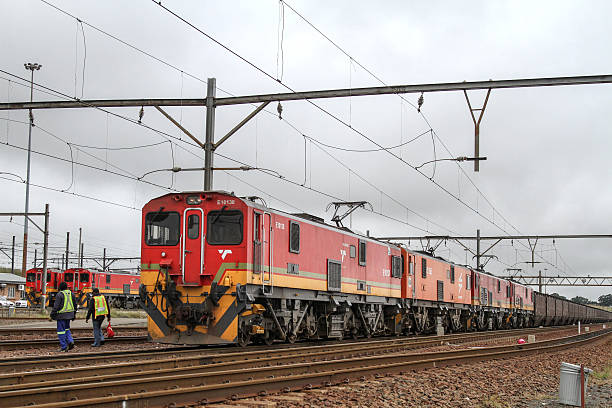
Private-sector participants will need to move about 65 million tonnes of cargo via South Africa’s rail network to help Transnet reach its annual target of 250 million tonnes.
Speaking at a Transport Forum presentation in partnership with the African Rail Industry Association and the Localisation Support Fund, rail logistics management executive Anand Moodliar said train operating companies would need to bring procurement events exceeding R30 billion in investment.
He noted that as much as R40 billion might be required overall to realise South Africa’s rail freight ambitions. Linking to the theme of “The Power of Local,” Moodliar emphasised that the current open-slot project, which allows private-sector participants access to Transnet’s network, will only succeed if cooperative, symbiotic relationships are prioritised.
Paraphrasing Transnet Group CEO Michelle Phillips, Moodliar stressed that balancing competition with cooperation is fundamental for public-private partnerships and rail freight growth.
He added that rail logistics alone is too expensive for South Africa’s GDP capacity, making a better modal split with road freight both possible and necessary.
Although Transnet has made improvements under CEO Phillips, Moodliar said the private sector needs to step up. Any train-operating company applying for slots must demonstrate that its usage adds value and does not simply displace existing rail cargo, he explained.
Moodliar noted that South African companies have historically underperformed in rail freight projects across the continent. He hopes the African Rail Industry Association will enable private-sector participation and emphasise the benefits of local involvement.
The road-to-rail shift faces challenges from road freight. Performance-based standards in trucking now allow payloads of up to 50 tonnes, with approvals for a fourth axle taking payloads to 60 tonnes. “Rail has to be even more competitive to enable modal shift, saving exporters money and driving jobs through mining and manufacturing activity,” Moodliar said.
He added that every million tonnes of new rail volume could generate about R100 million a year in access fees, funds that could improve network stability and infrastructure investment. “If we can fast-track more volume, we can immediately bring the cash needed to unlock more network stability,” he said.
“Rail freight in South Africa has reached a quo vadis moment,” Moodliar stressed, highlighting that coordinated private-sector investment, public-private partnerships, and competitive rail operations are critical to the sector’s future.