
Supply chain data reveals rerouting activity up more than 360% as shipping lines scramble to adjust routes around one of the world’s most critical maritime chokepoints.
Disruptions in the Strait of Hormuz have triggered a sharp rise in ocean freight diversions, placing additional pressure on global supply chains and major Gulf ports.
According to the latest Supply Chain Insights report by project44, average daily ocean freight diversions have surged by more than 360% as shipping lines adjust vessel routes to avoid the disruption affecting the corridor.
The report shows that daily rerouting activity has climbed from 218 diversions to around 1,010 per day. The highest spike was recorded on March 5, when 2,363 diversions were logged within a 24-hour period, the most significant level of rerouting activity yet recorded in the Hormuz shipping corridor.
As vessel traffic patterns shift, operational pressure is mounting across Gulf ports and downstream trade lanes. The data indicate that all major ocean carriers are modifying schedules, with Mediterranean Shipping Company accounting for about 59% of the diversions tracked in the report.
Outbound rerouting activity is particularly concentrated at key Gulf gateways. Major regional hubs such as Jebel Ali Port, Port of Abu Dhabi and Hamad Port are experiencing the highest volumes of diverted cargo as shipping lines redirect vessels.
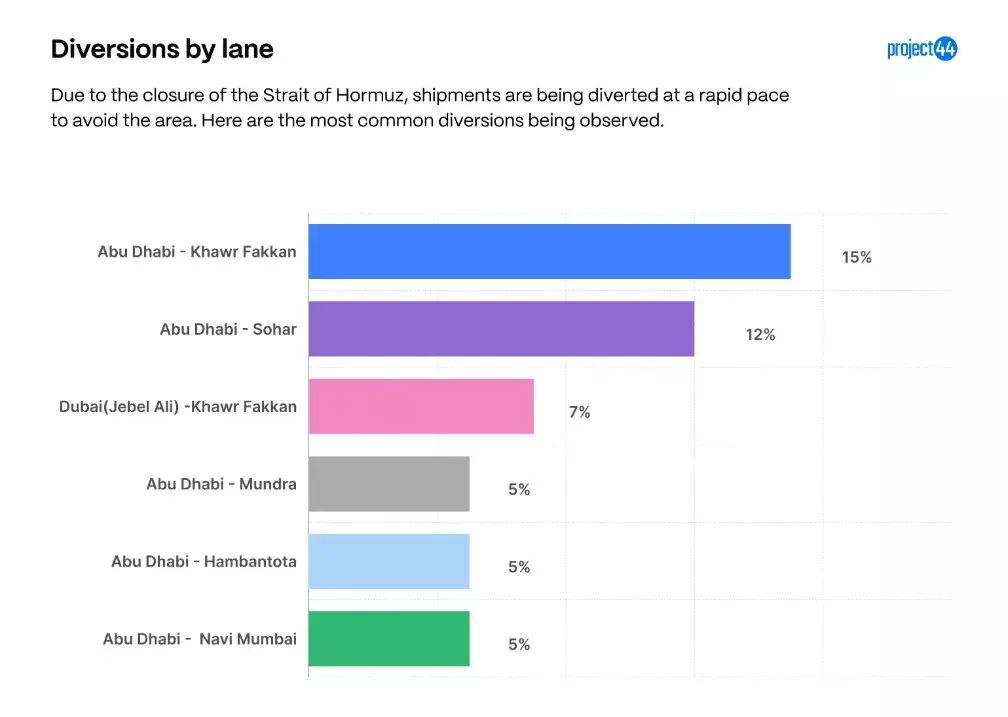
Other ports are also absorbing redirected traffic as carriers adjust their routes. Port of Khor Fakkan is capturing about 15% of total diversions, while additional volumes are moving through Port of Sohar, Port of Hambantota, Mundra Port and Mumbai Port.
The diversion of vessels is also contributing to rising congestion along Indian trade lanes. According to the analysis, arrival delays at Mundra could reach as much as 49 days, while departure delays at Jawaharlal Nehru Port have surged by 118%.
The report notes that, unlike previous maritime disruptions, there is no long-haul alternative route for cargo moving through the Gulf corridor. As a result, several ports are effectively cut off from direct ocean access, forcing carriers to rely on surrounding hubs to keep cargo moving.
With diverted vessel volumes continuing to accumulate across regional gateways, shipping schedules are expected to remain unstable. This could lead to extended transit times across Middle East and South Asia trade routes in the coming weeks.
The data also indicate that continued regional uncertainty and shifting war risk insurance conditions are adding further complexity to shipping operations, with no clear timeline yet for when normal transit patterns through the Strait of Hormuz may resume.
This article was originally published on Indian Transport & Logistics News (ITLN).