
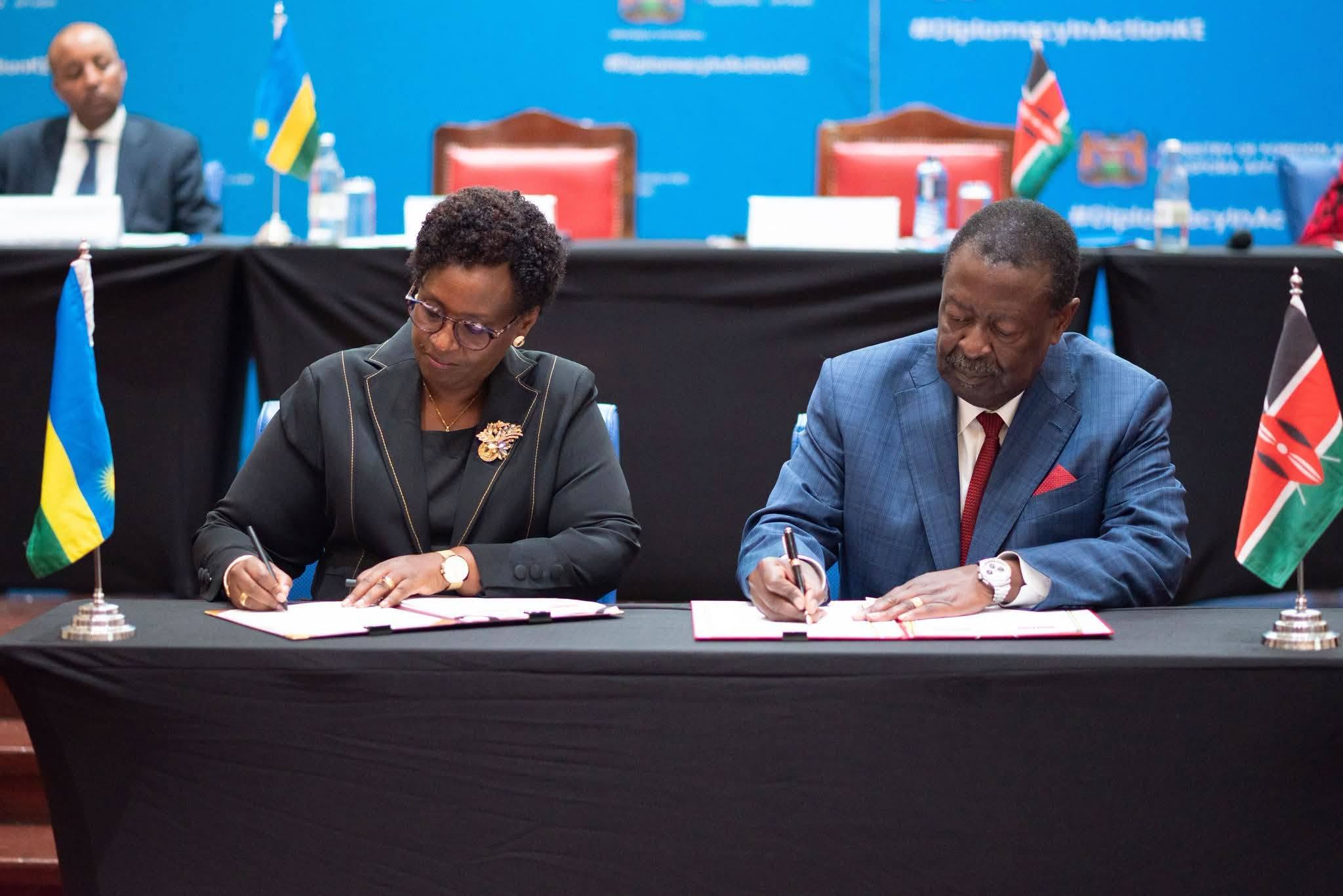
The agreements aim to improve cross-border trade, investment and regional connectivity, with the Northern Corridor and Port of Mombasa remaining key links in Rwanda’s supply chains
Kenya and Rwanda have signed 11 bilateral agreements to strengthen cooperation across several sectors, including trade, immigration, water resources, housing, local governance, conservation and justice.
The agreements, comprising two bilateral instruments and nine memoranda of understanding (MoUs), were concluded during the ministerial segment of the 10th Session of the Joint Permanent Commission for Cooperation (JPCC) recently held in Nairobi.
According to Kenya’s Ministry of Foreign Affairs, the agreements provide a framework for implementing existing bilateral commitments and expanding cooperation into new areas.
Kenya’s Prime Cabinet Secretary and Cabinet Secretary for Foreign and Diaspora Affairs, Musalia Mudavadi, who led the Kenyan delegation, reaffirmed the country’s commitment to strengthening its strategic partnership with Rwanda, particularly in trade and investment, infrastructure, transport and logistics, information and communications technology, and regional integration.
He emphasised the importance of facilitating the movement of people, goods, services and capital within the East African Community (EAC).
Rwanda’s delegation was led by Usta Kaitesi, Minister of State for Foreign Affairs and International Cooperation, who highlighted the potential to expand bilateral trade and strengthen regional integration through the African Continental Free Trade Area (AfCFTA) and the Northern Corridor.
Transport and logistics cooperation remains a key component of the relationship, with the Northern Corridor providing landlocked Rwanda with access to the Port of Mombasa, a major gateway for its imports and exports.
A recent milestone in this partnership was the arrival of Rwanda National Energy Company’s maiden 40,000-tonne cargo of refined petroleum products at Kenya Pipeline Company’s Kipevu Oil Terminal 2 on September 29, 2026.
The shipment marked the activation of a route enabling Rwanda to import bulk petroleum products through Kenya’s port, pipeline and storage infrastructure.