
Electric submersible pumps are proving highly effective in tackling stubborn water ingress, abrasive sludge, and sediment buildup that conventional pumps often cannot handle. They are delivering reliable and efficient dewatering in challenging African mining environments like Zambia’s Copperbelt and the DRC
If there is an expression to describe what African mining operations encounter when they go deeper underground in search of valuable ore, it is this: the deeper you go, the more challenging it becomes.
Certainly, one of the challenges they encounter is underground water ingress caused by heavy rainfall or natural seepage. This is particularly evident where ingress increases as barriers are breached or as depth increases.
Interestingly, underground water ingress accounts for a significant part of total water inflows. It ranges between 40 and 60 percent in some regions like the Democratic Republic of Congo (DRC).
Due to climate change, ingress due to heavy rainfall has become a burden even in semi-arid regions. This is prompting mining companies to spend significantly on pumping to maintain safety, prevent flooding, and sustain production.
Conventional submersible dewatering pumps
Typically, excess groundwater ingress causes sediment accumulation in underground dams, which requires the settled material to be re-suspended and dense sludge to be removed. Using conventional dewatering pumps to handle groundwater ingress, while it may work somehow, often proves problematic in handling this bottleneck.
As an alternative, electric submersible pumps have proved effective when deployed to remove ingress from underground dams as well as sumps, shafts, or collection points.
Why electrical pumps are preferred?
OEMs or their suppliers, based on shared information from recent industry reports, supplier announcements, and official case studies, with this publication. The information highlighted features that make submersible pumps effective for underground ingress: · Pushing water upward efficiently without priming issues. · Reliable in wet, harsh conditions: sealed, waterproof motors (often with multiple mechanical seals) prevent water ingress into electrical components. · Ability to handle solids, abrasives, and corrosive fluids common in groundwater dewatering. · No exhaust fumes, quieter, easier integration with power grids or generators. · This is particular in modern designs: features like variable frequency drives for energy efficiency and adaptability to fluctuating inflow rates. · They excel at pumping out dirty, abrasive, or slurry-laden water directly from sumps, shafts, or collection points.
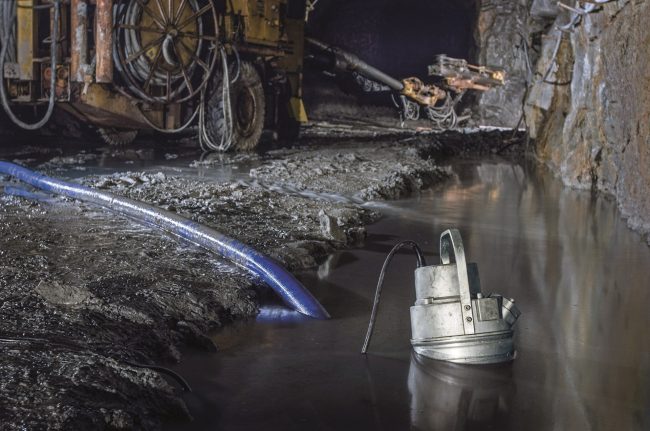
These features make the pumps more effective, as recent case studies demonstrated.
Case studies of success
Project updates underline that one of these features makes submersible pumps effective for safe operation metres below the surface to remove dirty, abrasive, or slurry-laden material at deep levels in dams underground.
At a mine in Zambia’s Copperbelt, severe sediment/sludge buildup drastically reduced underground dam capacity; this affected dewatering. Handling the high-density slurry was beyond what conventional dewatering pumps could manage.
Once deployed, an electric submersible pump from Grindex cleared the accumulation effectively, which restored capacity, facilitating effective dewatering. Specifically, the Grindex Bravo 400 – with its integrated agitator to re-suspend settled material, hard-iron construction for abrasion resistance, and ability to handle dense sludge – proved ideal where conventional pumps fell short, according to reports from Integrated Pump Technology, the regional distributor. This has contributed to growing demand for Grindex pumps across the Copperbelt for tough sludge and slurry removal in underground conditions.
In the DRC, at a remote copper mining operation which was going deeper, groundwater ingress and slurry-laden water became a challenge. To handle this, a fleet of pumps was used to run continuously to dewater. This ensured the continuity of production.
Similarly, recent updates indicate that fleets of Grindex units (from 5.5 kW to 90 kW) have been operating continuously since 2022 at major DRC copper mines. These provide reliable performance in high-inflow, deep-level environments where groundwater seepage usually intensifies with depth.
Efficiency and durability
Overall, these examples, among others, illustrate that electric submersible pumps have the durability, efficiency in handling abrasive slurries and sludge, and ability to maintain safe, productive operations in Africa’s challenging underground mining settings.