
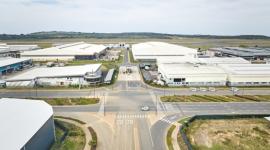
KwaZulu-Natal’s Special Economic Zone is expanding infrastructure, exports and global air connectivity as it positions itself for further industrial growth
Dube TradePort Special Economic Zone (SEZ) has attracted R4.2 billion in private-sector investment since its inception, while sustaining nearly 37 000 permanent jobs across KwaZulu-Natal, according to its latest Socio-Economic Impact Assessment Report.
The SEZ recorded a further R480 million in private investment during the 2025/26 financial year, with much of the capital coming from existing investors expanding their operations, equipment and capacity.
The latest investment supported the creation of 631 permanent jobs and 102 temporary jobs, reinforcing Dube TradePort’s role in driving industrial development and employment in the province.
Dube TradePort SEZ chief executive officer Hamish Erskine said the latest figures reflected the value of creating an environment where businesses can expand while benefiting from strategic infrastructure and access to markets.
“Our continued investment in strategic infrastructure and investor-focused development is creating a platform for sustained economic growth and industrial expansion,” Erskine said.
“Dube TradePort remains a powerful catalyst for attracting investment, creating jobs, and strengthening KwaZulu-Natal’s position in global markets.”
Exports strengthen
The SEZ is also making a growing contribution to KwaZulu-Natal’s export economy.
Businesses operating within Dube TradePort generated approximately R531 million in exports during the previous financial year, with products reaching markets across the Southern African Development Community (SADC) and other international destinations.
Erskine attributed the export performance to the SEZ’s integrated model, which brings together industrial infrastructure, logistics services and access to air, sea and road transport networks.
Dube TradePort’s location gives businesses direct access to King Shaka International Airport, the Port of Durban and road links connecting KwaZulu-Natal with markets across Southern Africa.
This combination is increasingly important for manufacturers and other businesses seeking to serve both domestic and international customers from a single location.
Infrastructure drives expansion
Infrastructure development remains central to Dube TradePort’s strategy as it prepares for further investment and industrial expansion.
During the 2025/26 financial year, the organisation invested R109.7 million in fixed capital projects. This included the completion of major infrastructure works in Dube TradeZone 2 and Dube AgriZone 2, as well as continued construction of large-scale industrial warehousing facilities.
The organisation is also preparing a new pipeline of capital projects aimed at meeting future investor demand and strengthening the SEZ’s long-term resilience.
Among the planned developments is a solar farm capable of generating at least 4.4 megawatts (MW) of renewable energy. The project is expected to support the sustainability requirements of investors while improving the SEZ’s energy resilience.
Dube TradePort also plans to construct two new industrial warehouses aimed at medium-sized manufacturers looking for modern facilities within the SEZ.
Planning is also under way for a new water reservoir, which will help ensure that critical infrastructure keeps pace with industrial expansion.
“These investments reflect Dube TradePort’s commitment to building a resilient, sustainable and future-ready Special Economic Zone that can support long-term industrial growth,” Erskine said.
The focus on infrastructure comes as businesses face increasing pressure to secure reliable energy, water and logistics systems while also meeting sustainability expectations from customers and international markets.
Building Durban’s global connections
Dube TradePort’s economic contribution extends beyond industrial infrastructure, with the organisation also involved in efforts to improve KwaZulu-Natal’s international air connectivity.
Through its participation in the KwaZulu-Natal Route Development Committee, also known as Durban Direct, Dube TradePort has spearheaded a review of the province’s Route Development Strategy.
The strategy aims to accelerate airline route development at King Shaka International Airport and improve access between KwaZulu-Natal and international markets.
The province’s existing connectivity has been supported by Emirates’ Durban-Dubai service and the growth of Airlink’s Durban-Harare route.
More recently, airlines have expanded services from Durban.
Qatar Airways has increased its Durban service to daily flights on the Doha-Maputo-Durban route, providing greater access to markets in Europe, Asia, North America and the Middle East.
Turkish Airlines has increased its Durban-Istanbul service to four flights a week, connecting passengers from KwaZulu-Natal to more than 300 destinations through Istanbul.
Eswatini Air has also increased its Durban-Manzini service to three flights a week, strengthening connections between KwaZulu-Natal and the Kingdom of Eswatini while supporting trade and tourism.
For Dube TradePort, stronger air connectivity forms part of a broader economic strategy. Better links to international markets can support investment, tourism, trade and the movement of people and goods, while strengthening Durban’s position as a gateway into the region.
Erskine said the combination of investment, infrastructure, exports and connectivity placed the SEZ in a strong position to contribute to KwaZulu-Natal’s economic transformation.
“With a strong investment pipeline, significant infrastructure expansion plans, growing export performance and increasing global air access, Dube TradePort continues to demonstrate why it is one of South Africa’s leading Special Economic Zones and a critical contributor to the province’s long-term economic prosperity,” he said.