
Industry leaders at Transport Evolution Africa Expo outlined how smarter border management, inland ports and greater collaboration can transform Southern Africa’s trade corridors and boost competitiveness
At the Transport Evolution Africa Expo held at the Gallagher Convention Centre in Johannesburg from June 9-11, industry experts and stakeholders gathered to discuss some of the most pressing issues facing African transport infrastructure.
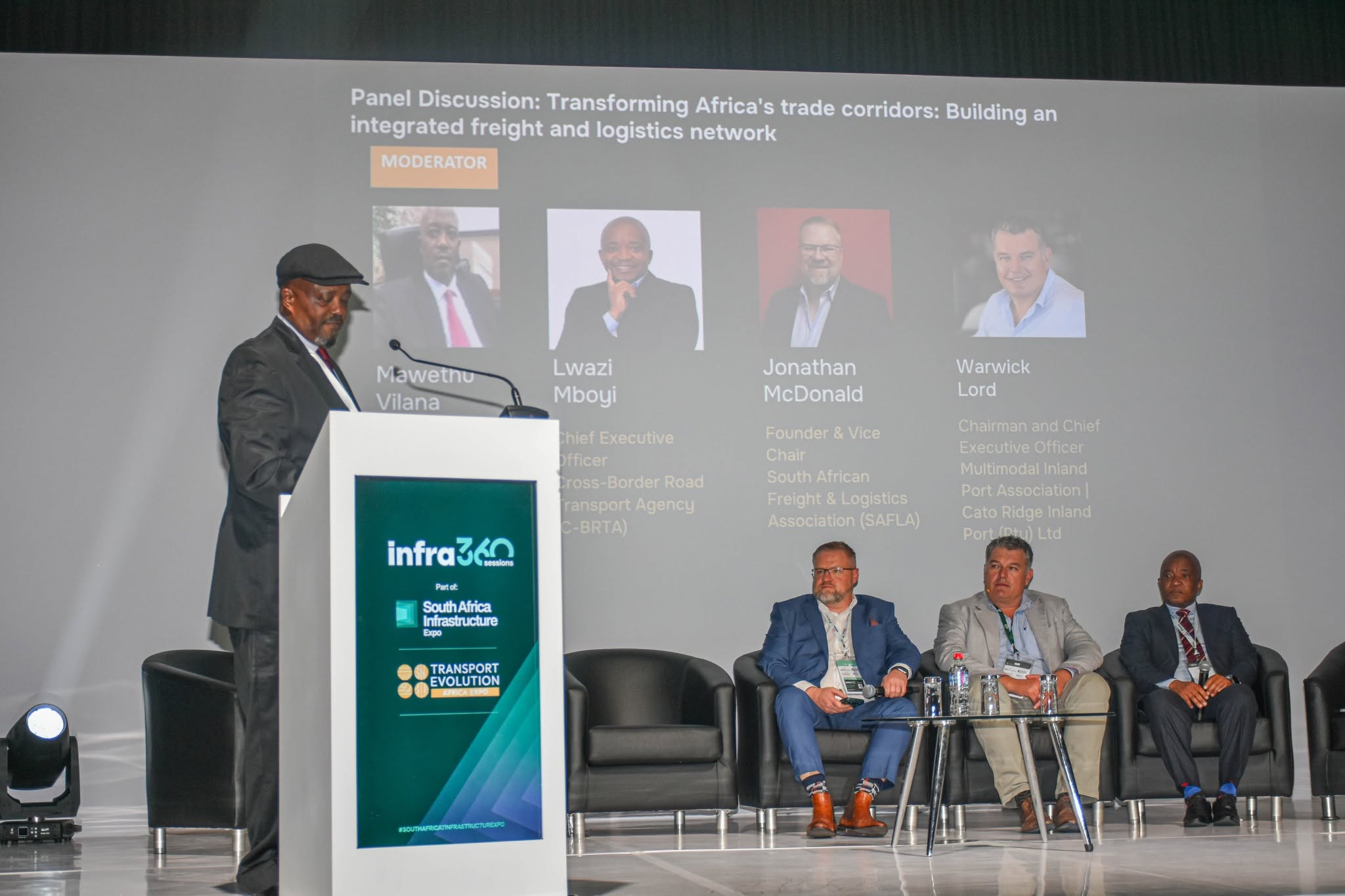
One of the standout sessions, Transforming Africa’s trade corridors: Building integrated freight and logistics networks, explored practical ways to better integrate road and rail freight to create seamless trade flows across the region. Moderated by Mawethu Vilana of CILTSA, the discussion focused on improving Southern Africa’s key trade corridors, enhancing border efficiency, and creating a more reliable logistics ecosystem.
The panel brought together industry leaders who agreed that while significant progress has been made in some corridors, greater collaboration between governments, regulators and the private sector will be essential to unlock the full potential of Africa’s freight network.
Maputo corridor demonstrates what is possible
Speaking from a regulatory perspective, Cross-Border Road Transport Agency (C-BRTA) CEO Lwazi Mboyi highlighted the dramatic growth in freight volumes moving through the Maputo Corridor and the lessons it offers for the rest of the continent.
According to Mboyi, truck traffic through the corridor has increased more than fourfold over the past few years, placing considerable pressure on border infrastructure and requiring extensive coordination between South African and Mozambican authorities.
“If you look at the situation four, five or six years ago, we were licensing about 400 trucks a day that go through the Port of Maputo. That number has now risen to about 1,800 trucks a day. That reflects a significant increase in the volume of freight that goes through the Port of Lebombo into the Port of Maputo and out into the rest of the world.
“It means that from a regulatory perspective, we have had to build our systems to support that transition and the increase in volumes crossing the border. It also requires alignment between all agencies involved so that freight can move more freely and efficiently,” Mboyi said.
He noted that one of the major achievements has been the closer integration between South African and Mozambican border officials, including co-location arrangements that have significantly reduced congestion and improved processing times.
Historically, queues stretching for kilometres along the N4 became a common feature of the corridor, creating safety risks, criminal activity and costly delays.
“Not so long ago, you would have heard about 20 to 30 kilometres of trucks lined up on the N4 on a daily basis, trying to cross to the Port of Maputo. That created serious challenges around road safety, crime and freight movement,” said Mboyi.
“We have since developed what is called the Kilometre 7 staging area, where trucks are processed away from the N4. Through collaboration between all stakeholders, the aim is that trucks can now approach the border without stopping, making the crossing far more efficient.”
He added that technology deployment and pre-processing facilities along freight corridors will become increasingly important to ensure cargo is inspected, weighed and accredited before reaching border posts.
Inland ports can ease pressure on seaports
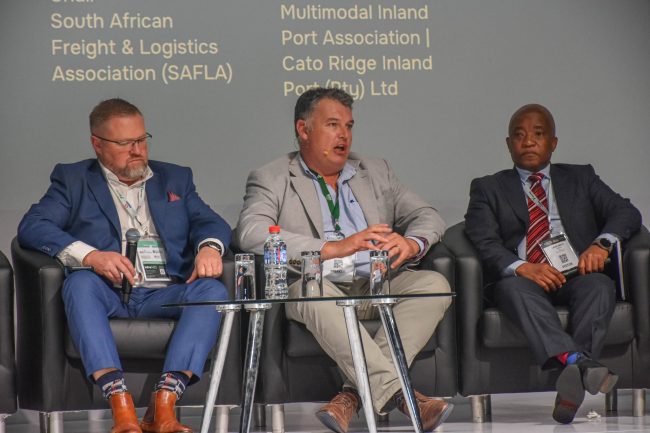
Warwick Lord, Chairman and CEO of the Multimodal Inland Port Association and Cato Ridge Inland Port, argued that inland ports have a critical role to play in creating a more efficient freight system and supporting the North-South Corridor.
He explained that inland ports function as extensions of seaports, helping to spread cargo volumes across multiple collection and distribution points rather than concentrating traffic at a single congested gateway.
“The cargo owners are looking for the most efficient and cost-effective route for their cargo, with as much robustness built into the system as possible,” he said.
“Inland ports act as outer-gate facilities for seaports such as Durban. Instead of relying on a single collection point, you create multiple gateways that allow cargo to move more freely. The more fluidity we can achieve in our seaports, the better the throughput and ultimately the better the outcomes for the entire logistics chain.”
Lord added that South Africa’s current logistics model often incentivises inefficient behaviour because it can be cheaper to send trucks directly into congested port areas than to utilise inland logistics hubs.
Beyond relieving pressure on seaports, inland ports also serve as aggregation centres where cargo can be consolidated and moved more effectively by rail.
“What inland ports do is bring cargo together in one location so that it can be moved efficiently by rail. Instead of trains moving with empty capacity in one direction, you can improve utilisation and make rail economically viable. Cargo aggregation and densification are critical if we want to shift more freight from road to rail and build a logistics system that is sustainable over the long term,” Lord added.
He stressed that transport infrastructure should operate according to a clear hierarchy, with ports functioning at maximum efficiency, supported by a strong rail network that reduces pressure on roads.
Reliability remains the missing link
While infrastructure development and technological advancements are important, Jonathan McDonald, Founder and Vice Chair of the South African Freight and Logistics Association (SAFLA), believes reliability remains the single biggest challenge facing the country’s logistics sector.
McDonald pointed to the fragmented nature of South Africa’s logistics environment, where numerous public and private stakeholders operate independently, often creating bottlenecks that ripple throughout supply chains.
“At the moment, we have a very fragmented logistics network within the different corridors we manage in South Africa. There are many public and private stakeholders involved, but they are not integrated.” McDonald said.
“Because of that, you only need one thing to go wrong or be delayed, and it creates a domino effect. Whether it’s law enforcement interventions, equipment breakdowns, scanner failures or compliance delays, the costs escalate very quickly.”
He argued that predictability is often more valuable than speed because businesses can plan around known transit times, whereas uncertainty creates inefficiencies and additional costs throughout the supply chain.
“One of the biggest things holding us back is reliability. Whether it’s cargo transport or a border post, what matters is having a reliable transit time. Businesses can plan around that. The challenge today is that you don’t know whether a shipment will take five hours or five days. That makes supply chain management extremely difficult and ultimately makes us less competitive in the global market.”
McDonald added that while South Africa already has many of the required technologies and strategic plans in place, success will depend on integrating the various players and ensuring systems perform consistently every day.
Building the freight corridors of the future
The discussion highlighted that transforming Africa’s trade corridors is not simply about investing in new infrastructure. It also requires smarter border management, stronger public-private partnerships, greater regional cooperation and the effective use of technology.
The success of the Maputo Corridor demonstrates what can be achieved when stakeholders align around a common objective, while inland ports such as Cato Ridge offer a blueprint for reducing congestion and strengthening rail freight. Ultimately, however, the competitiveness of Africa’s logistics sector will depend on creating a reliable, integrated network where freight can move predictably and efficiently across borders.